Matt Leacock: The design of The Four Doors followed a long, meandering route. It was the result of four different designers working alongside four different publishers to produce no fewer than five different games. I thought it’d be fun and enlightening to show just how much time, energy, and iteration can go into what (on the surface) might look like a fairly straightforward card game.
Please welcome one of the game’s co-designers, Matt Riddle (Matt R). Matt R will join me as we describe these five games below. Each iteration had its own strengths and each successive game improved on the former, until we were able to pull everything together into the final product, The Four Doors.
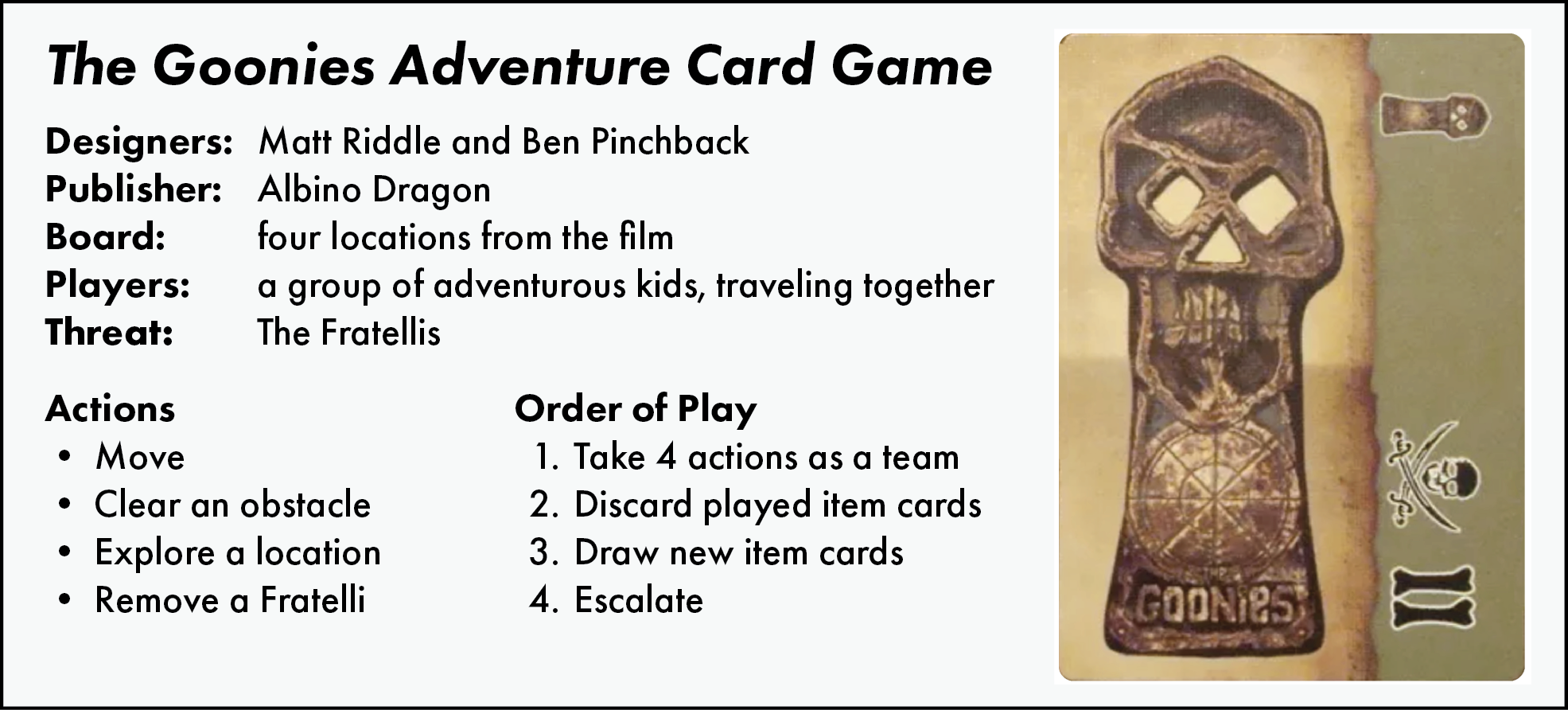
Believe it or not, our story starts with Matt Riddle and Ben Pinchback’s The Goonies: Adventure Card Game (2016).
Matt Riddle: After we made The Goonies, things did not go as planned (more on this below). I remember saying to Ben, “Now, I understand everyone's stuff is emotional right now. But I've got a Three Point Plan that's going to fix EVERYTHING.
Step 1. We’ve got this guy, Matt Leacock.
Step 2. ???
Step 3. He is going to fix EVERYTHING.”
So really, more of a two-point plan… Goofy movie quotes and false humility aside, I reached out to Matt about the possibility of working together with no expectations. Ben and I aren’t nobody, but still, Matt could have completely ignored me, and I would not have thought any less of him. Turns out, he is actually super cool and was willing to take a look at our design idea that we wanted to squeeze into his world, more on that soon. I did not expect it to be the circuitous journey that it was, but I could not be happier with where it ended up.
And so, it all started with…
The Goonies: Adventure Card Game
Key dates
Design started: Early 2015
Published: 2016
Matt R: Designing games on spec is HARD. “On spec” means that a publisher asked us to work on a game with a specific set of requirements, or to a specification. As engineers (Ben and I are both engineers IRL) we deal with specs all the time. I am pretty sure Ben’s real-life job is to take the spec from the customers and take them down to the engineers. He is a people person. Designing Goonies was hard and easy at the same time. Mechanically, we knew it had to be a co-op, and the spec said it had to be a card game. That was easy, let's just be inspired by the best co-op game on the planet, Pandemic! I mean this, this is not made up, we literally designed a card game based on Pandemic over 10 years ago and then tried to convince Matt L that it should indeed BE Pandemic The Card Game later on. Life is crazy.
Matt asked me to explain how Goonies works, and I will, I promise. Eventually. We very quickly had the structure of moving between locations and clearing obstacles (cards) using cards from your hand while holding off the Fratellis (threat meter and events). That was the “easy” part. The hard part was making it a Goonies game. We learned a lot when we designed a Back to the Future game that was, well, a game. Again, a card game, mechanically solid, but it did not FEEL like Back to the Future. It didn't deliver the feeling of BTTF that people expected when playing. On Goonies, we worked really hard to remedy that through characters and shared team turns and a general sense of adventure. As much as we could with 100ish cards (again, that pesky spec).


The locations from The Goonies: Adventure Card Game
Fast forward a few years, and Goonies has sold pretty well, but we had yet to receive payment for said project. It happens more than you think. The publisher hit hard times, and the check was in the mail for YEARS. This is a hobby for Ben and me, so it was annoying, not harmful, but it still suuuucckkkeeddd. That all led to the above two to three point plan. I knew we would make DOZENS of dollars to split three ways with Matt L., and they might even put our names on the box under his… but prolly in MUCH smaller letters.
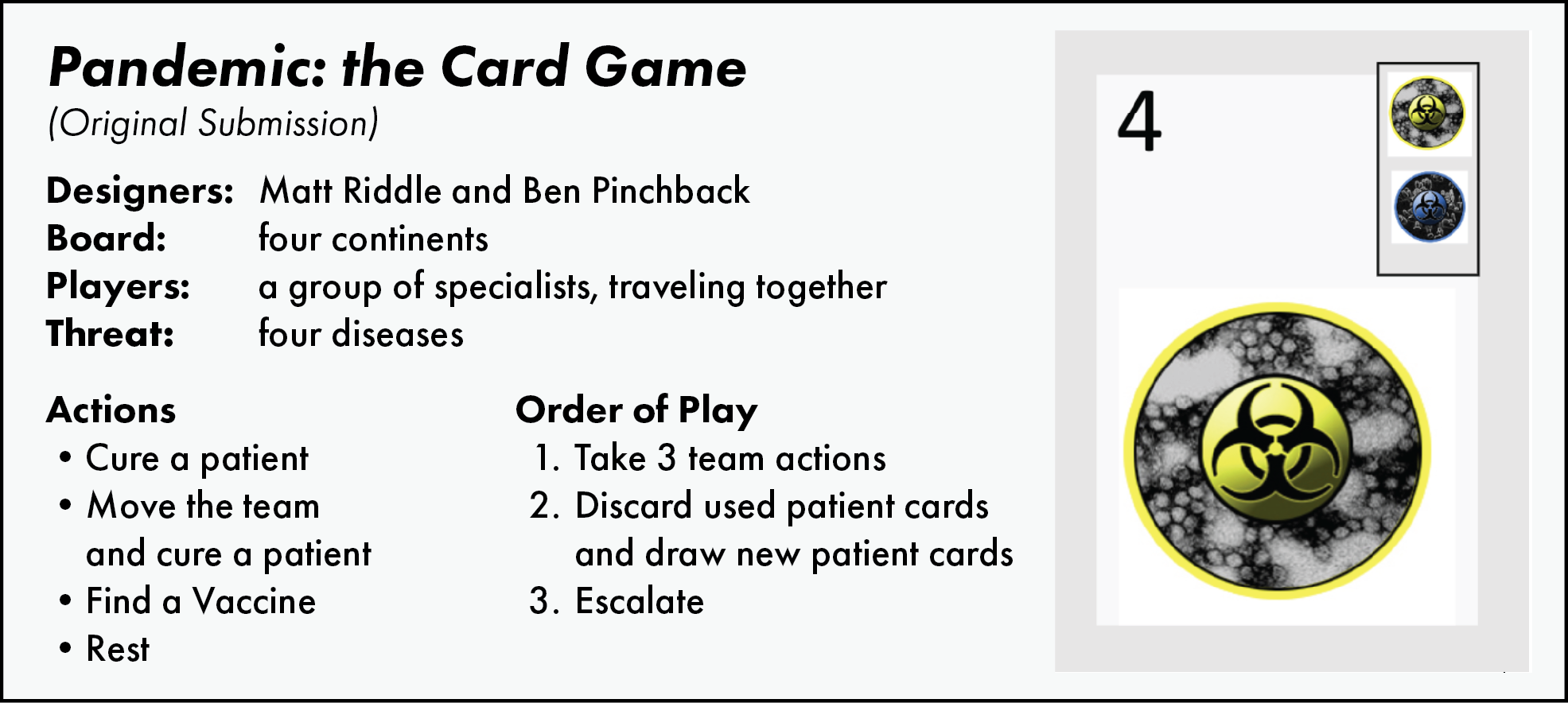
Pandemic: The Card Game (Pitch)
Matt R & Ben’s Initial Submission
Key dates
Matt Riddle first emailed Matt Leacock on: 9 November 2018
Prototype Submitted: 22 January 2019
What elements did you change in The Goonies in order to make it feel more like Pandemic for your pitch?
Matt R: Most of the original Goonies core design elements – locations with accumulating threats that need to be kept under control, the team turn, the card management – made it into the Pandemic redo.
We changed the way Fratellis (escalation events) worked as many of them made a lot less since in the context of Pandemic, mechanically and thematically. Our design efforts were more around tweaking balance and incorporating any consistent feedback that Goonies received, which we felt could help that game.
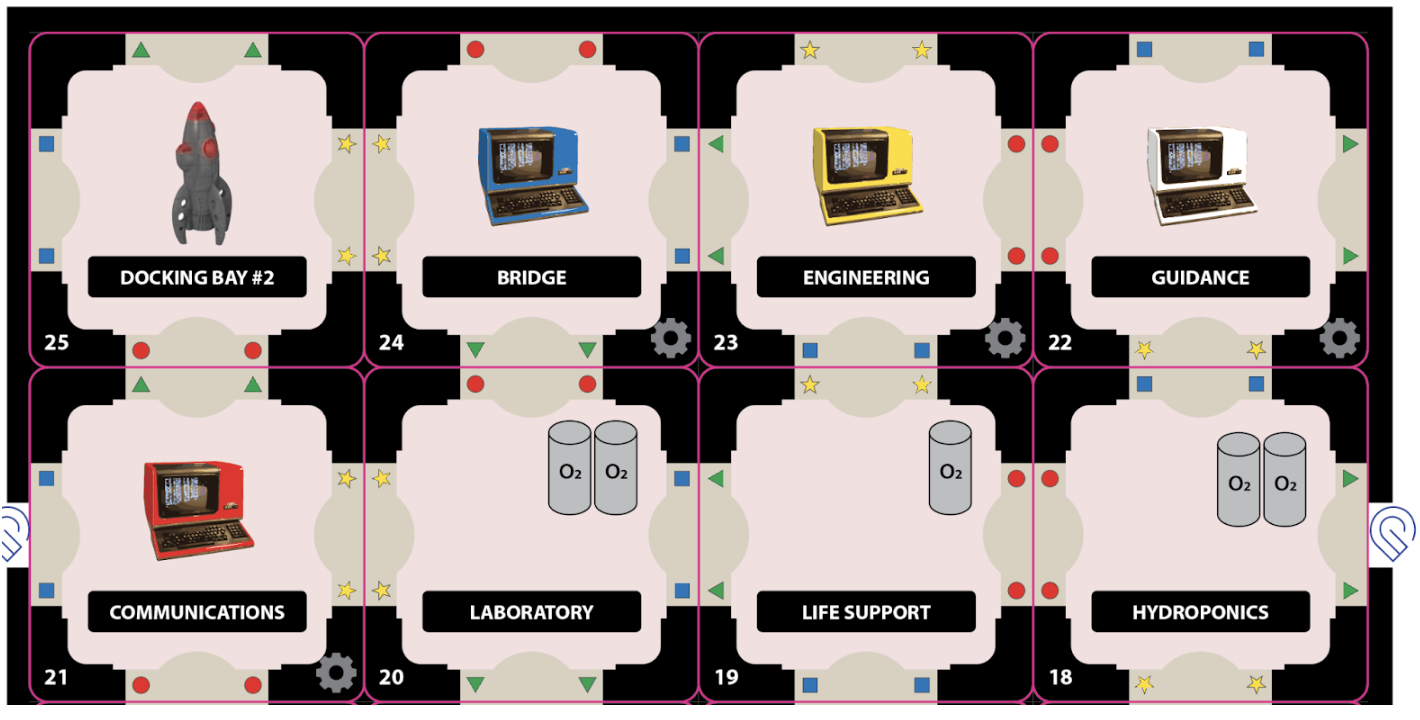
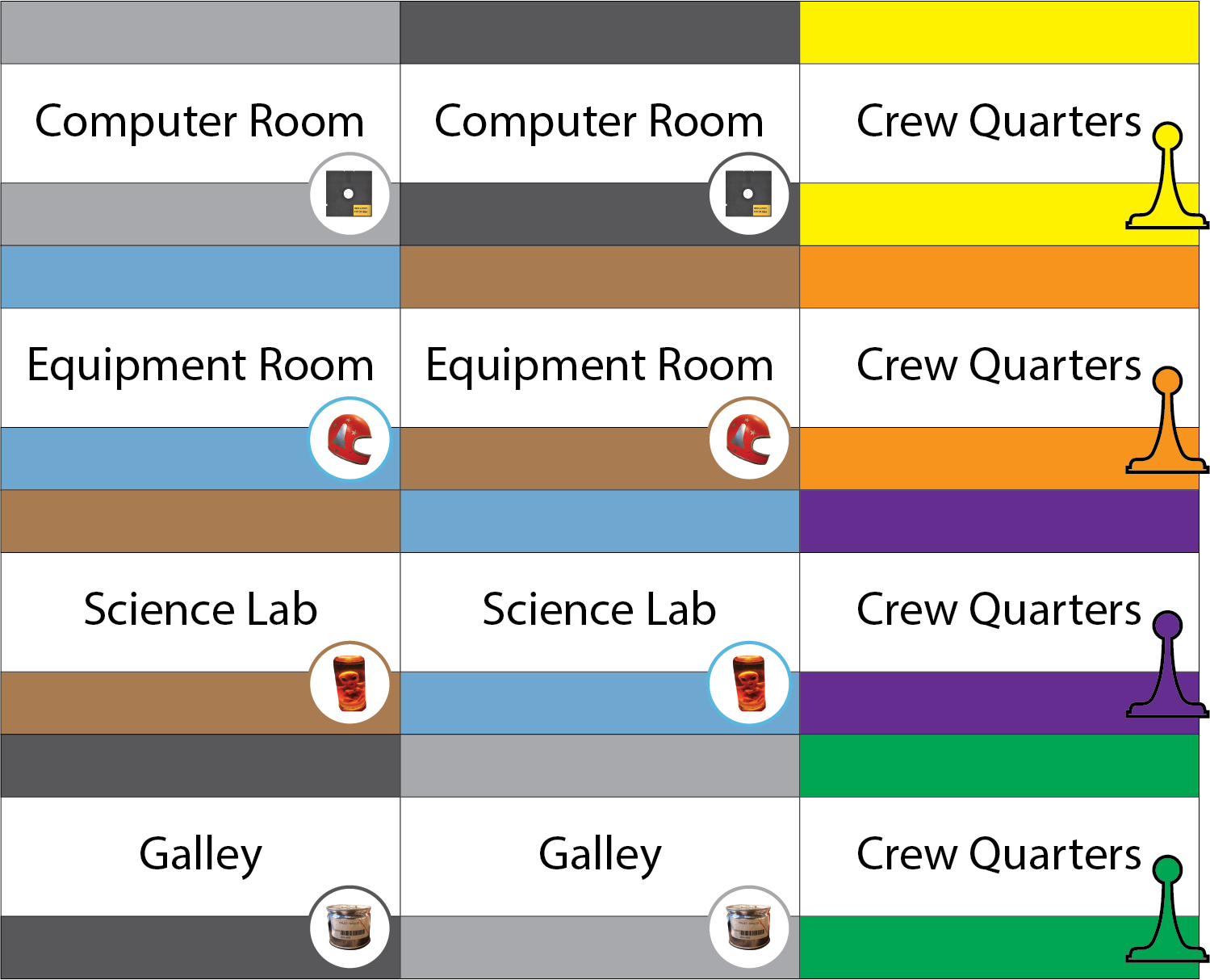
The four cards that made up the board in Matt R and Ben’s initial submission.
Matt L: I took their original submission apart, put it back together with input from them, and iterated on it for two years until it was…
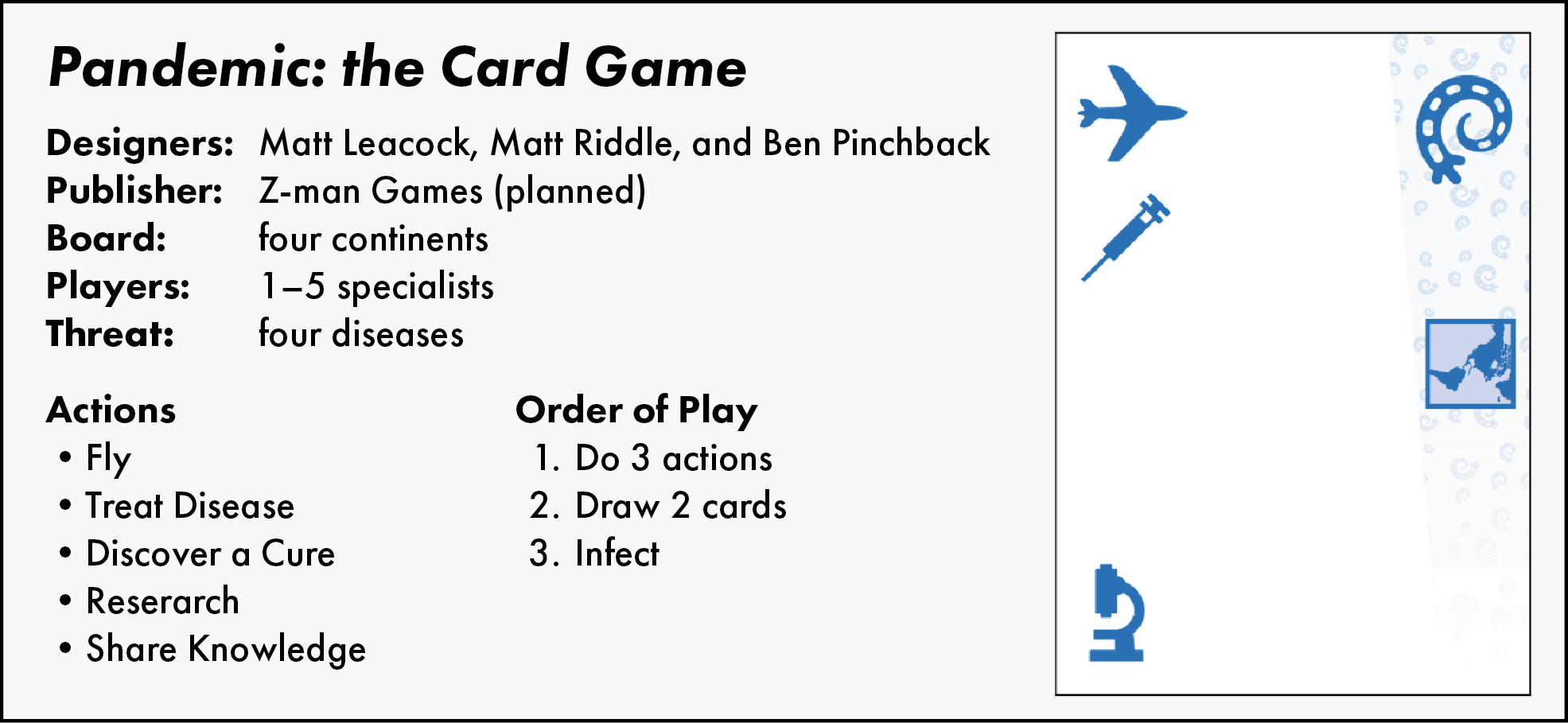
Pandemic: The Card Game
Key dates
First design journal entry: 8 March 2019
Last design journal entry: 28 January 2020
What from the originally submitted prototype stayed the same?
Matt L: Many of the fundamentals of the original submission carried over into the final version of Pandemic: The Card Game. Players took actions using multifaceted cards to move, treat disease, and meld cards to cure diseases. The same deck of cards was used for both player actions and to track the disease as it spread in the world. Players each had a role-specific power. Disease accumulated in specific regions, and once they passed a threshold, an outbreak occurred. You won the game if you discovered four cures, and you lost the game if you had too many outbreaks.
What changed in the developed version?
Matt R: It was fun going back and forth with Matt and watching our game turn into Pandemic while still seeing the core parts of the Goonies design. I wanted to say one of the hardest things in game design is killing your darlings. You will see in the next section that Matt helped us do that when we moved from a single pawn and “group turn” to individual pawns and turns. While the former could accentuate the master gamer problem, we did our best to design around that. Also, don’t be that guy. All that said, the game was BETTER after the change, it just took some time to get there. No one has ever accused me of lacking confidence, and I do not suffer from imposter syndrome. Neither should you BTW, do that thing you have been thinking about, the world needs your voice too, I promise. BUT still, I couldn’t help but think, why does Matt need us on a Pandemic game? He could totally move on and do it himself, but he did not because he is a good guy. And also, we are pretty dang good at making card games, look ’em up.
Matt L: In order to increase player agency, I gave each player their own pawn and turn (instead of having the players play collective turns with pooled actions). To simplify things, I also decoupled “Move the team and cure a patient” into two separate actions, Fly and Treat. Giving each player their own pawn also meant they could meet to share cards, leading to the introduction of the Share Knowledge action and the need to coordinate in order to discover cures.
Matt R and Ben had four cards that had “specialist” abilities on them that could be played for a special effect and then removed from the deck. These added a lot of strategic depth, so we developed them into a larger set of event cards. Because these cards were removed from the deck (and not discarded) when used, this opened up a new loss condition: if the draw and discard deck ever ran out when you needed a card, you lost the game.
I removed the Rest option – where you took fewer than the allocated actions in order to draw additional cards. This seemed to reward inaction which felt against the spirit of needing to take urgent action. Instead, I introduced the Research action which simply lets you draw 1 card for an action.
To increase tension, I introduced an infection rate. Each time you reshuffle the deck, you advance a token along a track. At certain thresholds, advancing this token increases the number of cards you need to draw during the Infect step. This led to the third loss condition: if the infection rate marker ever reaches the end of the track, you lose the game.
The four locations from the developed version of Pandemic: The Card Game.
Other Changes
One of the earliest tasks was renaming most of the nouns and verbs in the game to be consistent with the Pandemic board game. Patients became disease, epidemics became outbreaks, curing became treating, escalate became infect, specialist became event and so on.
I removed the requirement that forced you to treat all the disease in a given location before you could discover a cure since it felt grindy, didn’t fit the theme particularly well, and wasn’t how the board game worked.
I removed the idea that when you tried to discover a cure, you’d have a 50% chance of success (a holdover from The Goonies) since that just felt random to me.
I simplified the way treating became more effective once a cure was discovered.
I changed discarding so it was carried out as part of each action that required it, rather than a discrete step in the order of play.
Abandoned Ideas
Matt, Ben, and I briefly explored a zombie theme and a realtime version of the game, but quickly abandoned both ideas. Pandemic has always been about “science not violence” so zombies were out and the real time version didn’t feel like a Pandemic game.
Why was the game abandoned?
Matt L: While Z-man was open to the idea of the game, I was really uncertain about how it’d fit into the product line. We already had Pandemic: The Cure (the dice version of the game) and Pandemic: Hot Zone – North America was already planned as a simpler, more portable, entry product. It wasn’t clear that there was enough room for another simplified Pandemic game. As such, we kept kicking it down the road when it came to planning a release.
Matt R: If the game had not ended up being as awesome as it became as The Four Doors, I think I would have flown to Matt’s house and pulled a Say Anything to try and change his mind and get Pandemic the card game in the hopper. Luckily, I didn’t resort to that, and it all worked out in the end. Though Matt and his family missed out on me scream singing IN YOUR EYES THE LIGHT AND THE HEAT. Their loss, really.
Matt L: A real shame.
Instead of being serenaded, time passed, until one day, I had an idea. If there wasn’t much need for a simplified version of Pandemic anymore, perhaps a simplified version of a more complex game (such as Pandemic Legacy) would work. I pitched the idea to Rob Daviau and Z-man and they were both excited about the potential and decided to come on board. This could open up a new category of game!
We tentatively called the resulting project…
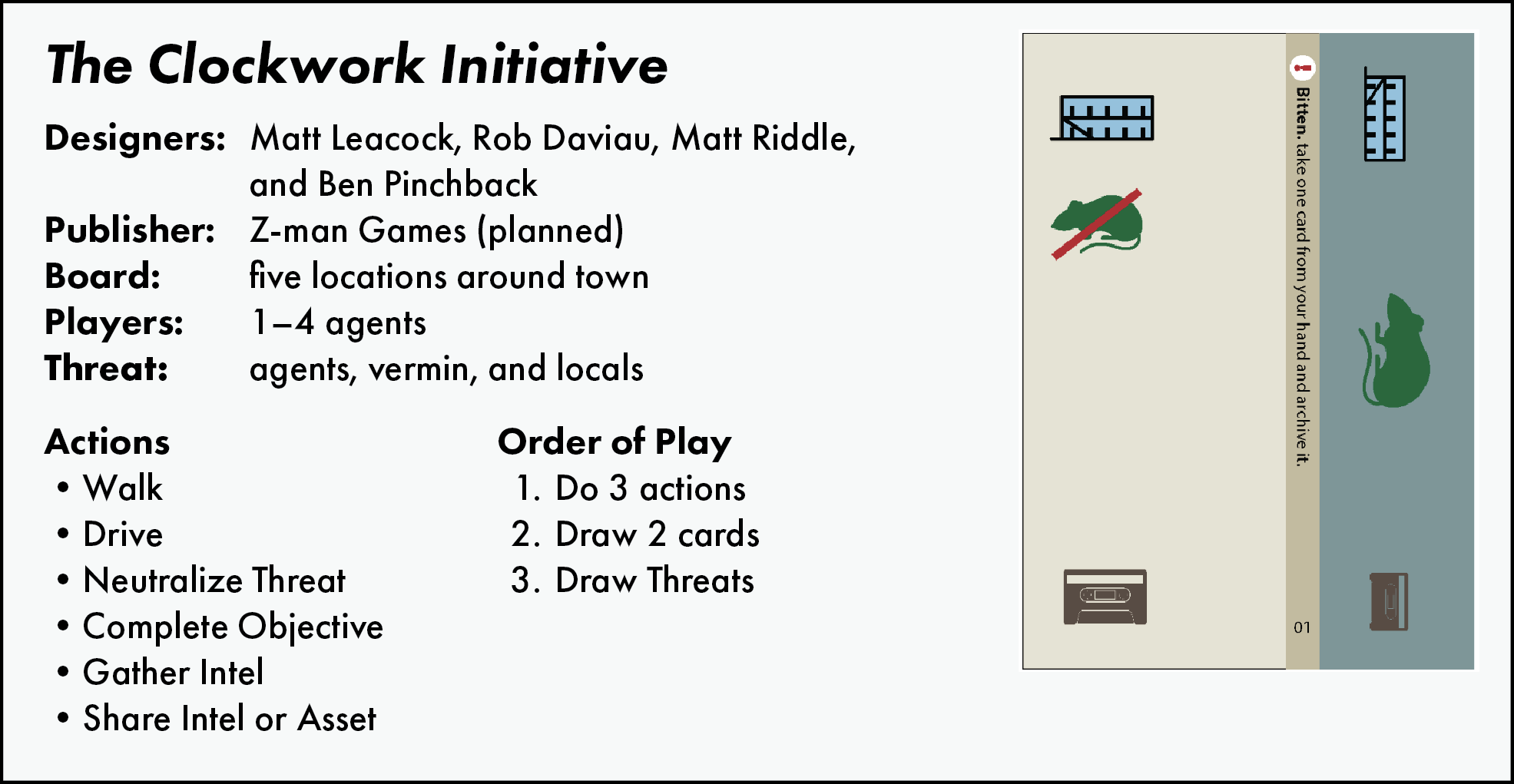
The Clockwork Initiative
(a Pandemic Legacy Card Game)
Key dates
First design journal entry: 21 January 2021
Last design journal entry: 27 June 2022
What changed in this new version?
Matt L: We took Pandemic: The Card Game wholesale and developed a story and campaign to layer on top of it.
Matt R: I have never suffered from imposter syndrome a day in my life. My Midwest white guy confidence is off the charts, my parents did TOO good a job with my self-esteem. That said, I spent months on calls with Matt and Rob, barely contributing. Ben and I would test an iteration and give feedback here and here, but it was Matt’s show. Ben and I are slow, we meet once a week, generally and pick away. By the time Ben and I would test, Matt L likely had fixed anything we found AND made a new build. He was very gracious about that lol.
Matt L: We worked with Rob to craft a story of agents tracking down enemy threats, avoiding toxic vermin, as well as prying locals in a six-chapter genre thriller set in the ’70s. Players basically played Pandemic: The Card Game, but their abilities, equipment, and objectives changed from chapter-to-chapter as the story unfolded.
This led us to explore the design space even more, which increased the number of events in the game.
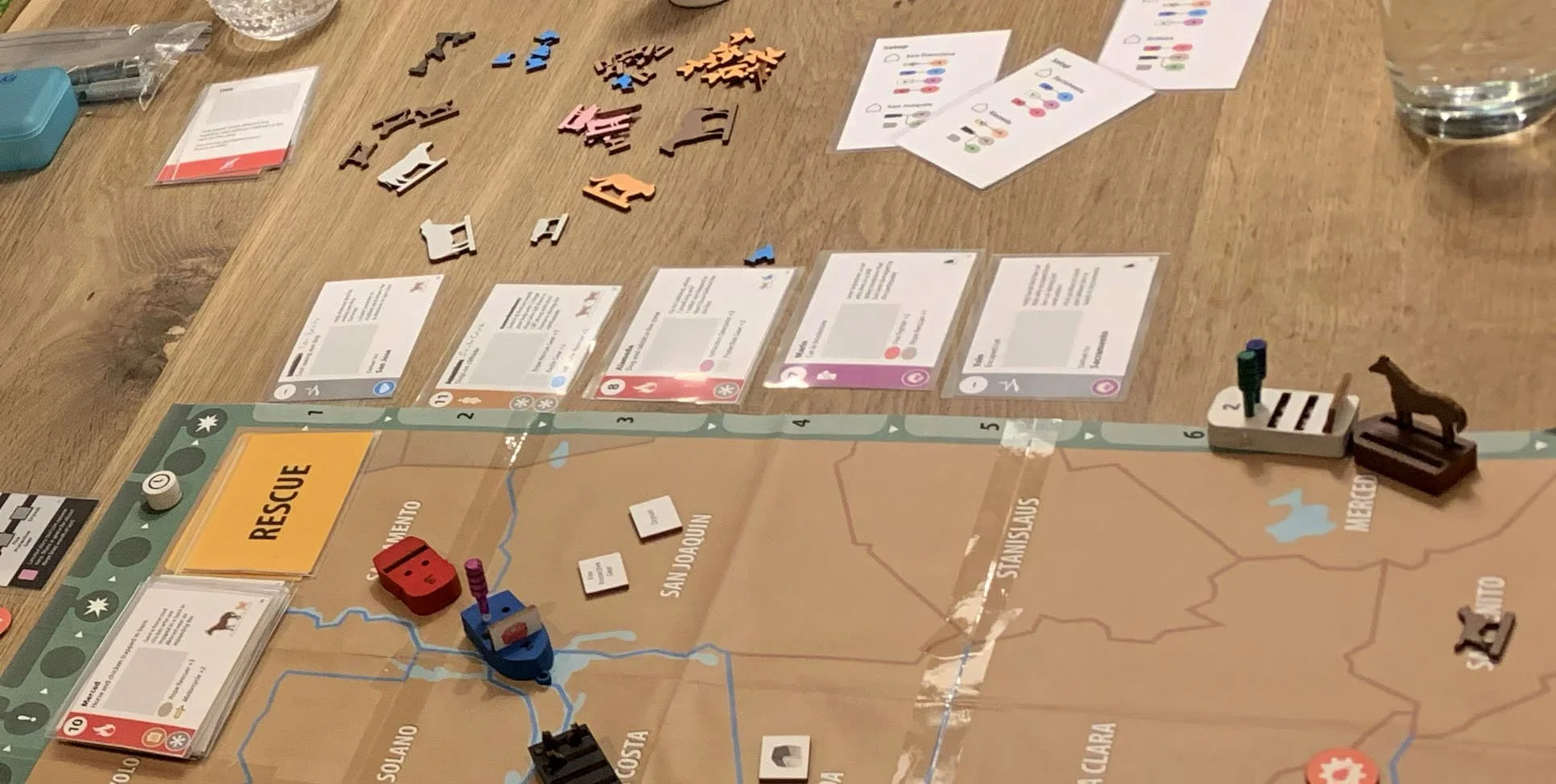
The Clockwork Initiative was set in a gritty 70s townscape.
Matt R: The Four Doors? More like the four designers, amirite? This part was really cool for me. We were already working with Matt L, and now Rob Daviau as well. Especially because I am not a storyteller. I like theme and I want it to make sense in games, but I don’t read flavor text. I don’t read the paragraph at the front of a rulebook telling me some lore about being a farmer, or ship’s captain, or monster hunter, or post-apocalyptic delivery driver. I want theme in as much as it does not get in the way of rules and my understanding of the game. So to watch Rob develop this whole story system and adjust mechanics and actions to account for that was really, really exciting as a game designer.
Why was the game abandoned?
Matt L: The game was a lot of work… and we simply weren’t having much fun doing it. We took a hard look at the numbers. Since it was a card game, it would have a fairly low price point and we’d be splitting the design royalty four ways. It would be a really heavy lift for a fairly modest reward. Ultimately, we were happy to put our tools down and move on to other projects.
Rob D: Hi, just wandered in to note that I spent a year of my life on this and then Matt kicked me out of the band. “Creative differences” he said. “Going in a new direction,” he said. There was also murmuring of me “bringing everyone down to my level.” If you know Matt, or Mr. Leacock as he demands I call him, you know he’s a cruel vindictive person full of spite and I should’ve seen this coming. (Actually, this was fun to work on for a bit, until it wasn’t. It was never going to be a great game in this iteration so I bowed out and wished everyone luck, including Mr. Leacock.)
Matt L: <coughs> The project then lay fallow for some time, until one of the good folks from Gamewright (who had tried the game out at a conference) wondered if it might make a good Forbidden card game.
I took a look. It would. The result became…
The Forbidden Island Card Game
Key dates
First design journal entry: 15 February 2023
Last design journal entry: 4 September 2023
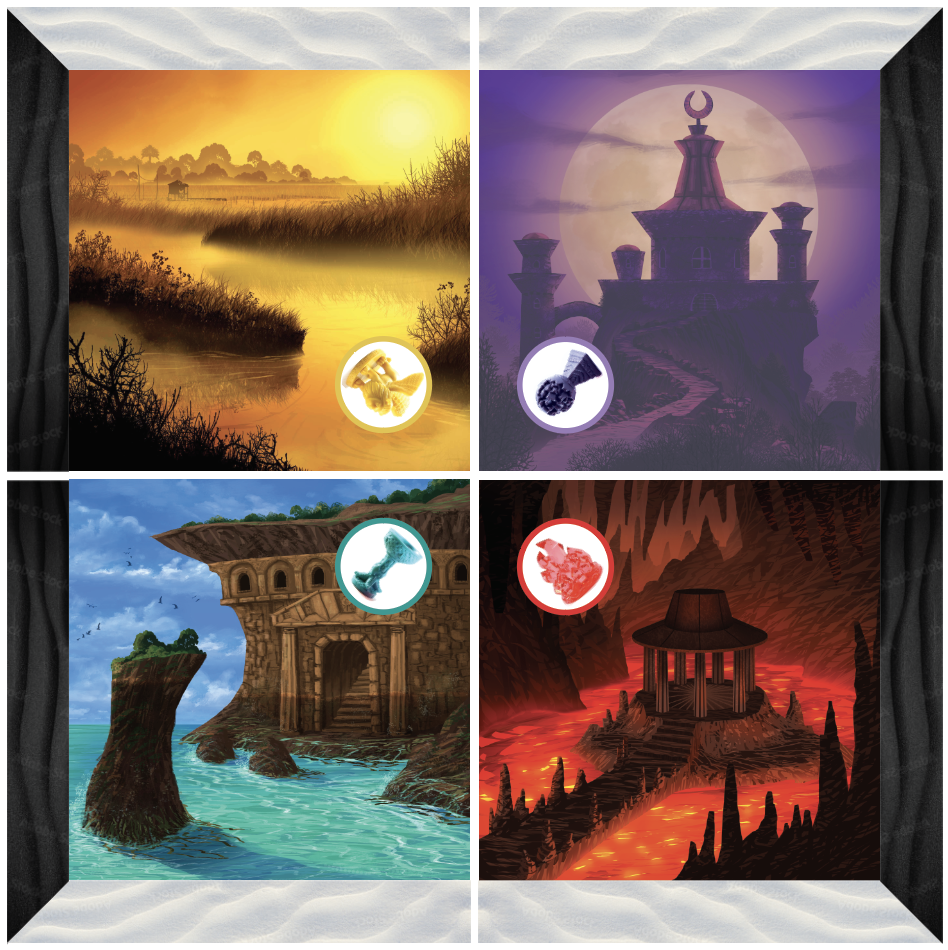
I made the game’s card square and arranged them into a 2x2 grid to form the island. Each location had two different “shores” that could be threatened.
What changed in this new version?
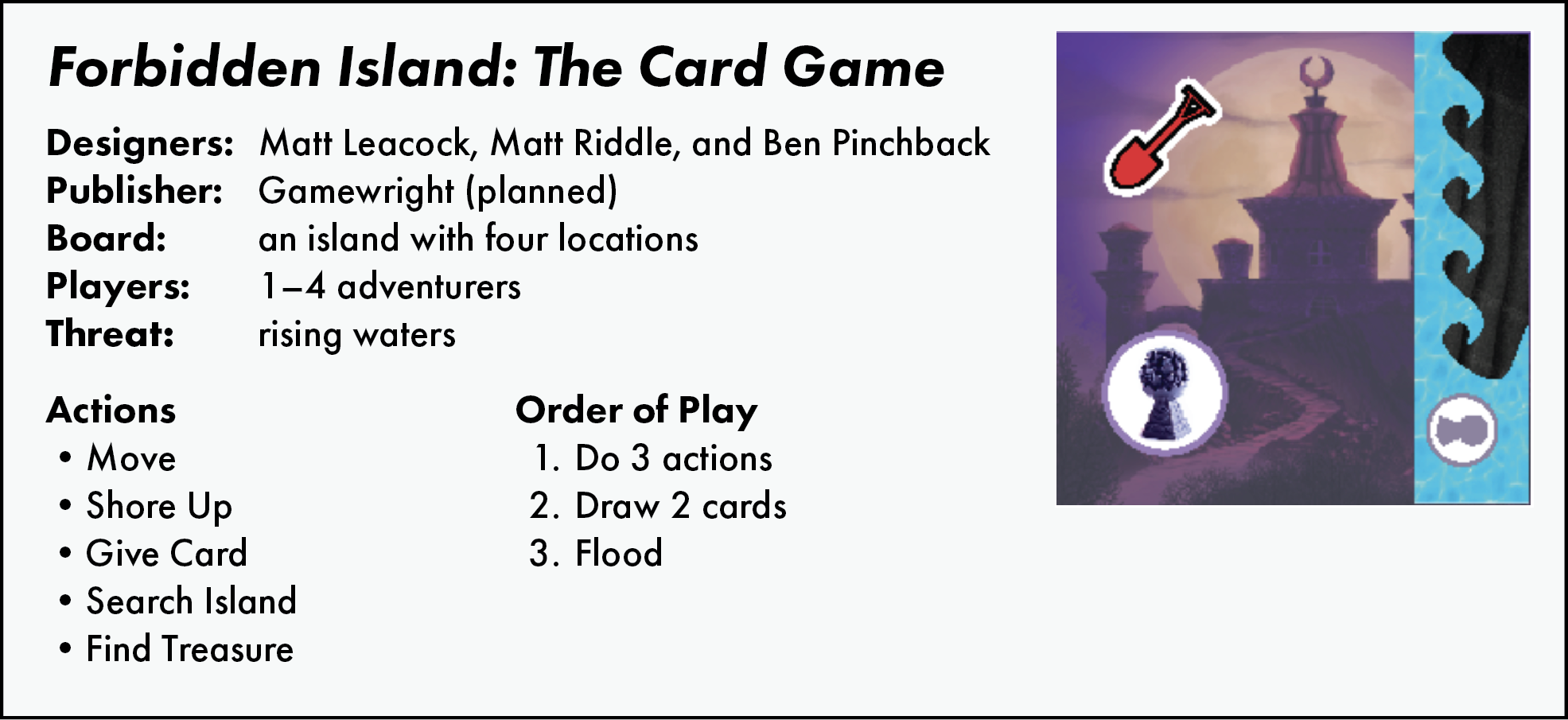
Matt L: In order to make the “island” for the game, I removed one of the game’s locations (reducing the number of locations from 5 to 4), made the cards square, and arranged them into a 2x2 grid. Since it didn’t make a lot of sense to Fly around the island (the board was much more compact), I dropped the Fly action and let players simply move to adjacent locations for an action, like they could in the Forbidden Island board game.
Instead of having an improved Treat ability when each cure was discovered, players would find treasures that unlocked a new power for the adventurers who held them.
Matt R: You will notice less and less of my witty repartee in these sections, and that is because, as I mentioned before, Matt L could have dropped us at any time, and we wouldn’t have complained or thought less of him. Sure, the DNA of Goonies has survived and evolved and improved throughout this process, but Matt L’s effort had far outstripped ours at this point. If that game had suddenly been released as Forbidden Island: The Card Game I would not have blinked twice. (I know Matt L. never considered it; he is a man of integrity, honor, justice, and the like, but just saying.)
Why Was The Game Abandoned?
Matt L: I developed the game fully to spec, turned it in, and eagerly looked forward to its production and release. Then, after reevaluating their plans, Gamewright decided to cancel the game. So it goes. (Remember fellow designers: always be sure you get an advance upfront.)
I put the game into File 13. Perhaps something would come of it someday.
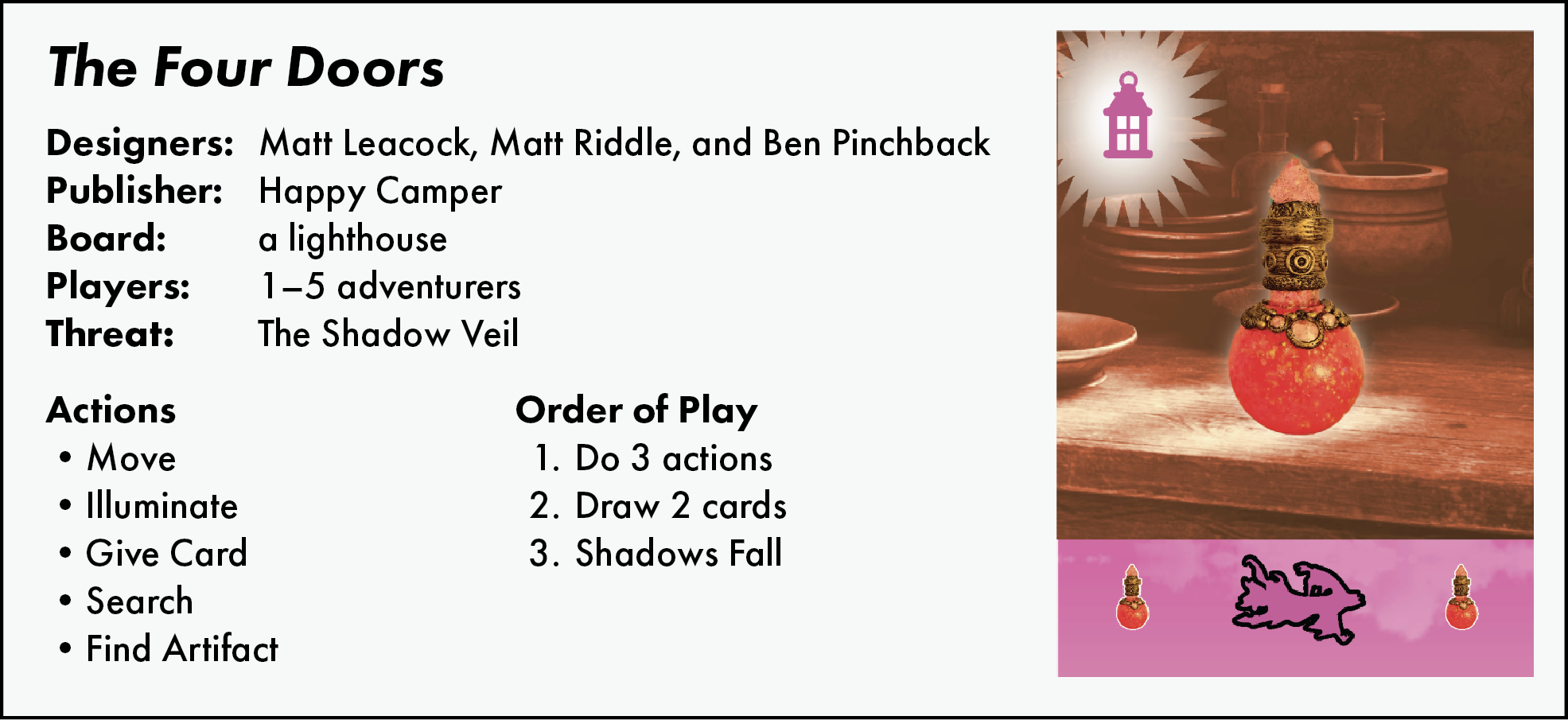
The Four Doors
Key Dates
First design diary entry: 3 September 2023
Last design diary entry: 23 March 2025
Published: August 2025 (Gen Con)
Matt L: I was fortunate that Jason Schneider of Happy Camper (who had originally commissioned the game when he was at Gamewright) remembered the game and asked what had become of it. I was happy to tell him that it was still available. We got to work!
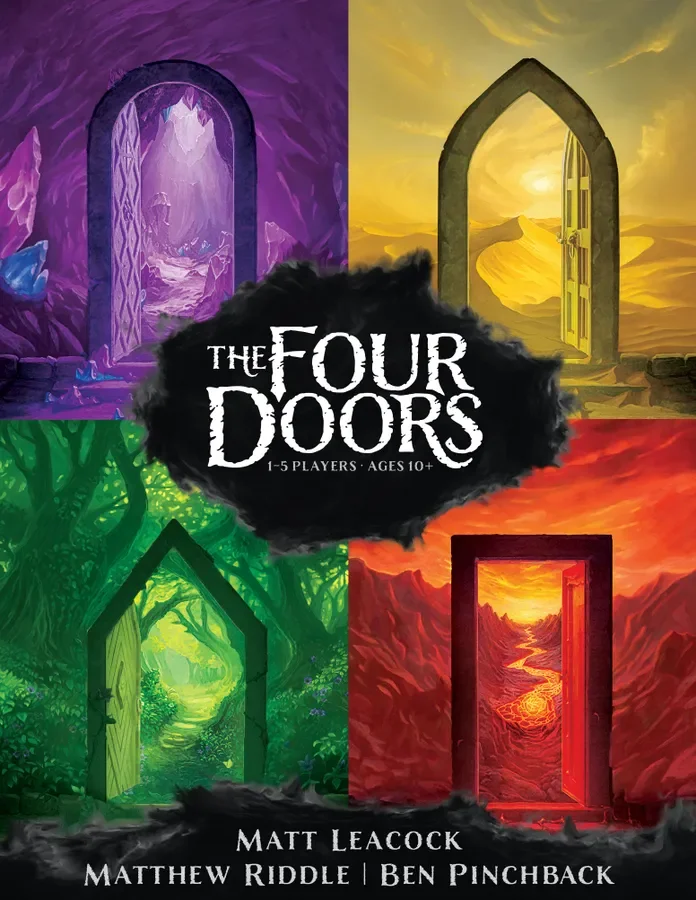
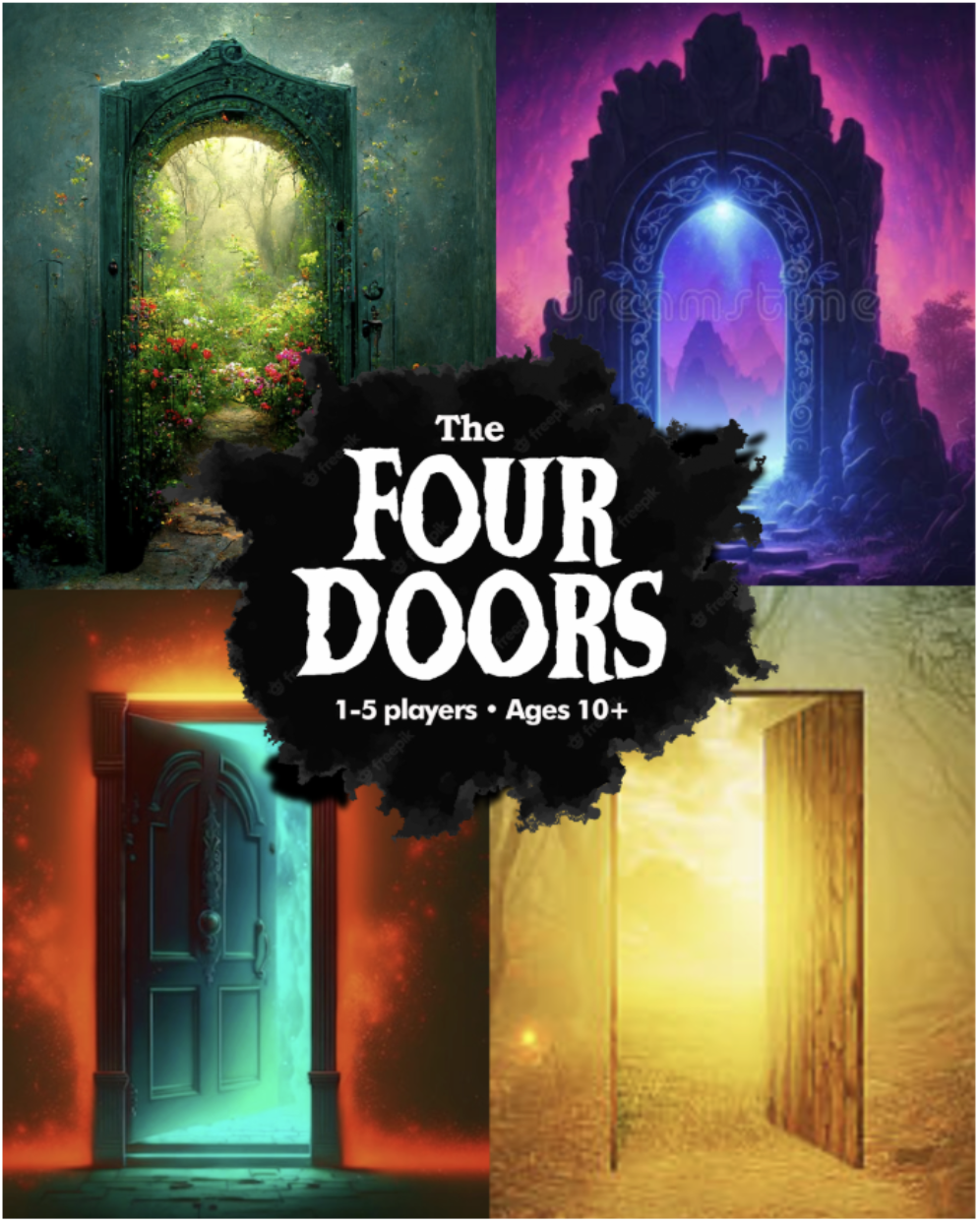
This cover composition prompted The Four Doors’ setting, threats, and goals.
What changed in this new version?
Matt L: Jason suggested a treatment early on: “In the clearing of an overgrown forest stand four mysterious doors. Behind each door lies fantastic treasure, but also imminent peril!”
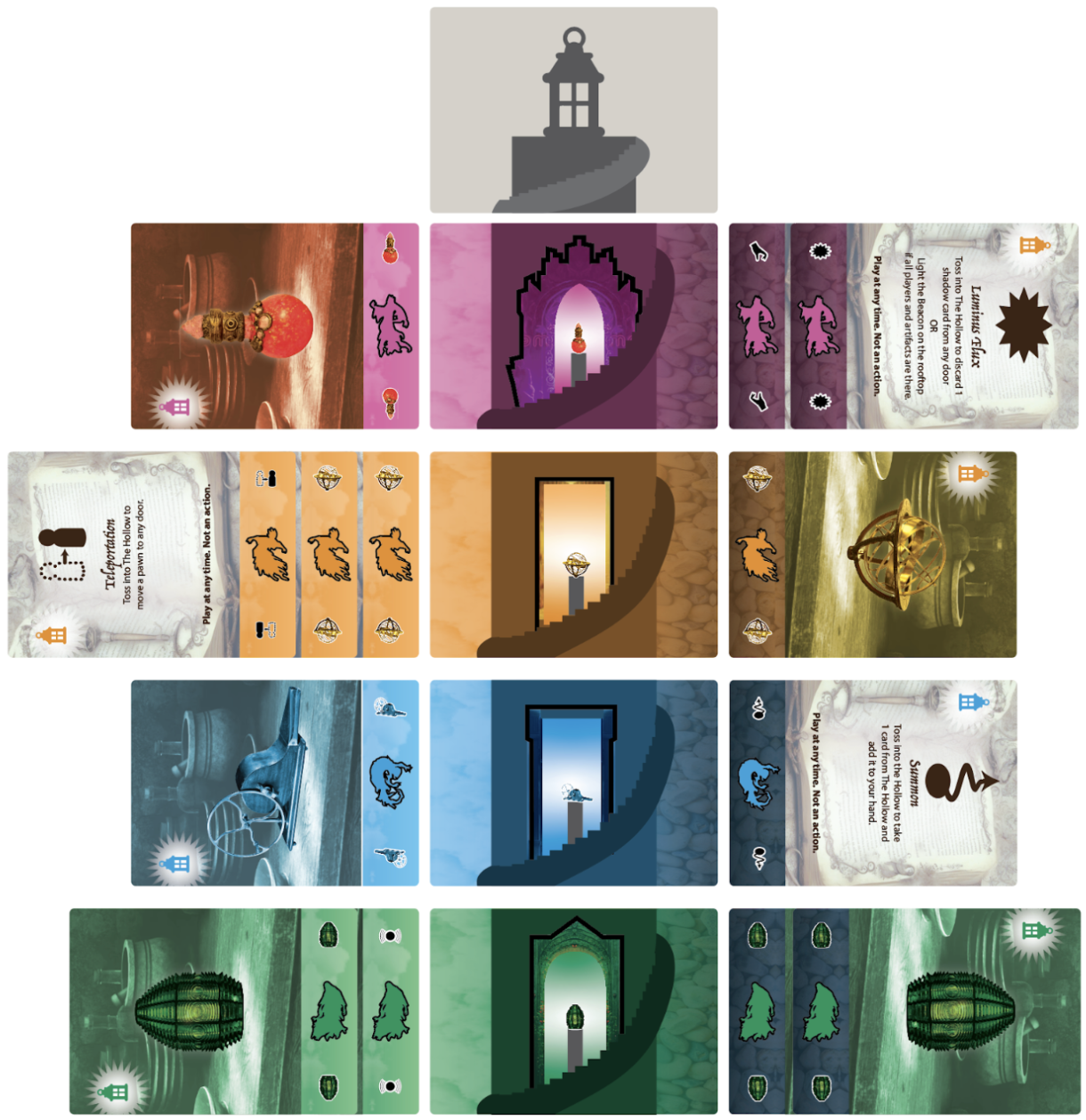
I ran with it. The shadowy threats could be dispelled by illuminating them. The doors could contain the treasures the adventures needed – but they could be closed off if the players weren't careful. I experimented with the door card layouts and came up with the idea of stacking them into a tower. That opened up the idea of a lighthouse with a magical beacon on top. This in turn led me to change the treasures into the relics needed to light the beacon to dispel the shadows forever.
I stacked the four doors to form a lighthouse. The beacon card (on top) came soon after.
Most of the work in this version was spent trying to make the game as accessible as possible. One of the biggest development tasks was making it abundantly clear where each card goes on the table, how to stack and overlap them, and how to understand them in each of these states. I also spent additional time on all the phrasing of the spell effects and adventurer powers.
Another task was refining the solitaire version. I found the recent work I did on the solo mode for The Lord of the Rings: Fate of the Fellowship rewarding and applied some of that same energy to The Four Doors. I wanted to make sure that the solo mode wasn’t just a patch or afterthought and worked to ensure that every card was usable and balanced when you played the game on your own.
At Last!
Matt L: The game premiered at Gen Con in 2025 and I couldn’t be happier with the final result. The mechanisms were refined over the five different incarnations and the product design really came together in this latest version. If you haven’t seen the shimmer on the lit beacon and the relic cards, you really should check them out – they’re nearly blinding!
So happy that Matt R and Ben patiently came along all the twists and turns. The game is better for it.
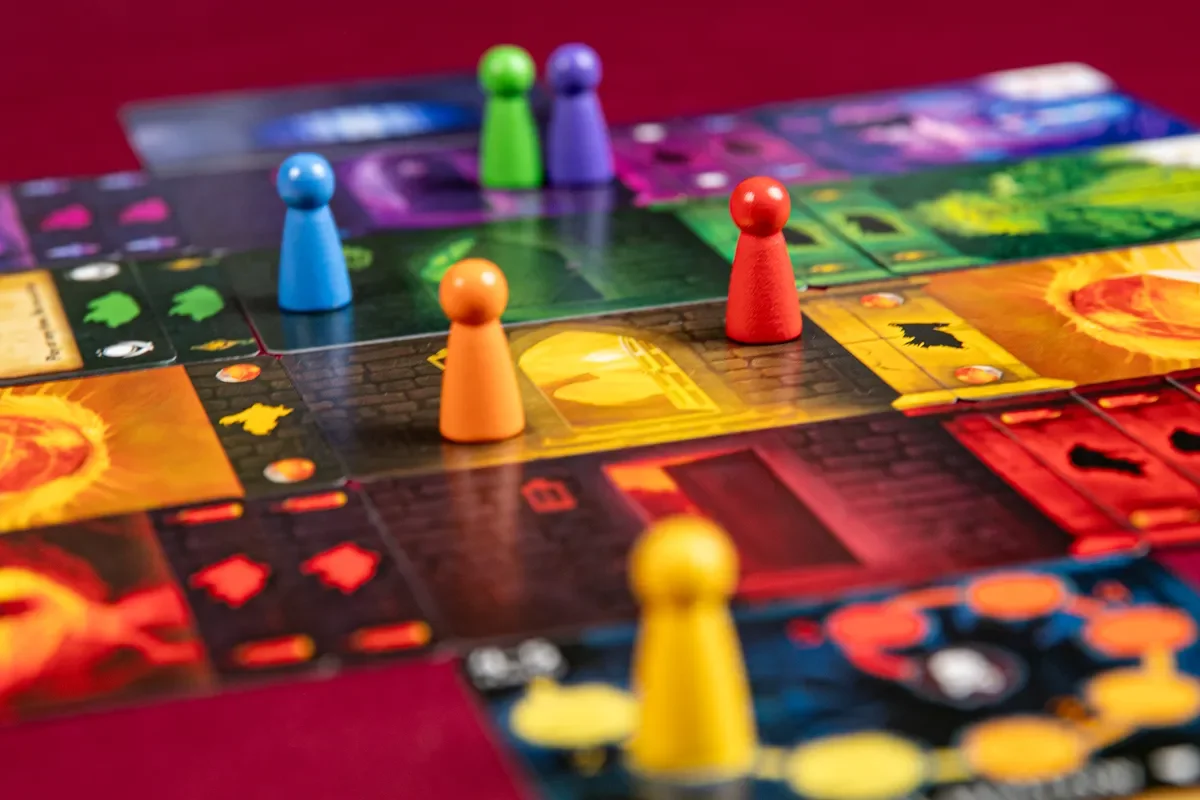
The published game, in progress. Photo courtesy of Ilya Ushakov.
Bonus Material
Some additional odds-and-ends that illustrate the game’s development.
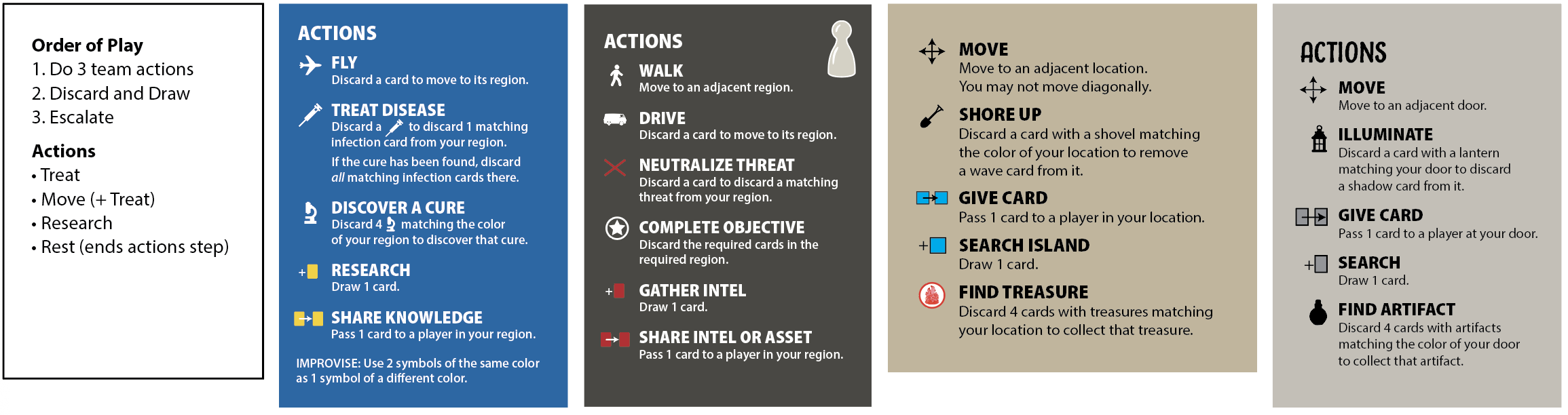
Reference card evolution. Left-to-right: Ben and Matt R’s initial submission (typeset by me), Pandemic: The Card Game, The Clockwork Initiative, The Forbidden Island Card Game, The Four Doors
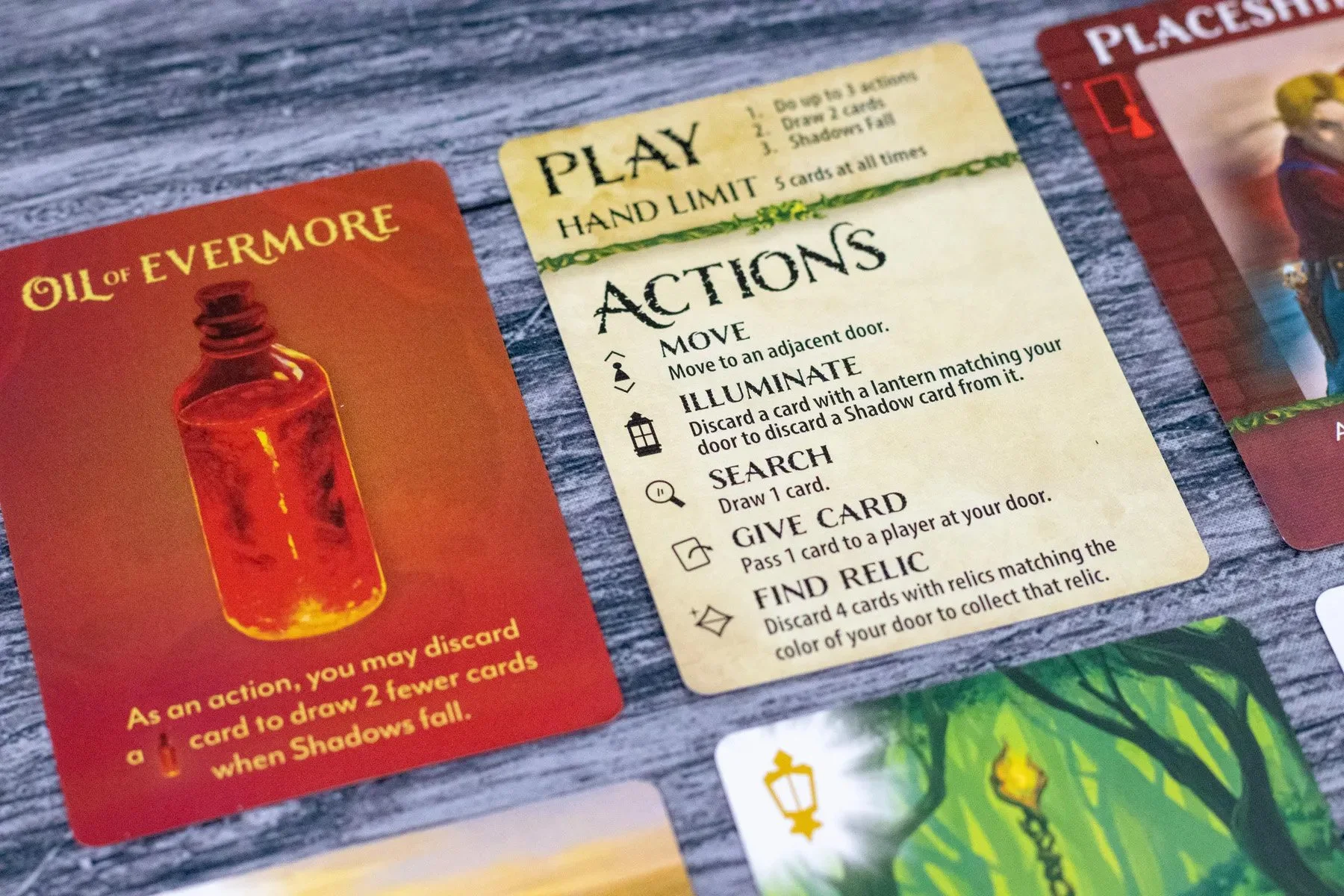
Player card evolution. Left-to-right: The Goonies: Adventure Card Game, Ben and Matt’s initial submission, Pandemic: The Card Game, The Clockwork Initiative, Forbidden Island: The Card Game, The Four Doors , prototype and early proof.
A big top with four doors
When I was translating Forbidden Island: The Card Game (with its square board) into The Four Doors, a briefly considered setting the game in some sort of a building or tent with a door in each corner. I wasn’t able to pull that together into an overall theme or story, so I abandoned it.